Post 10 - Rapidly Progressive ILD Phenotype

About RP-ILD

Bhavin Jankharia

Case:

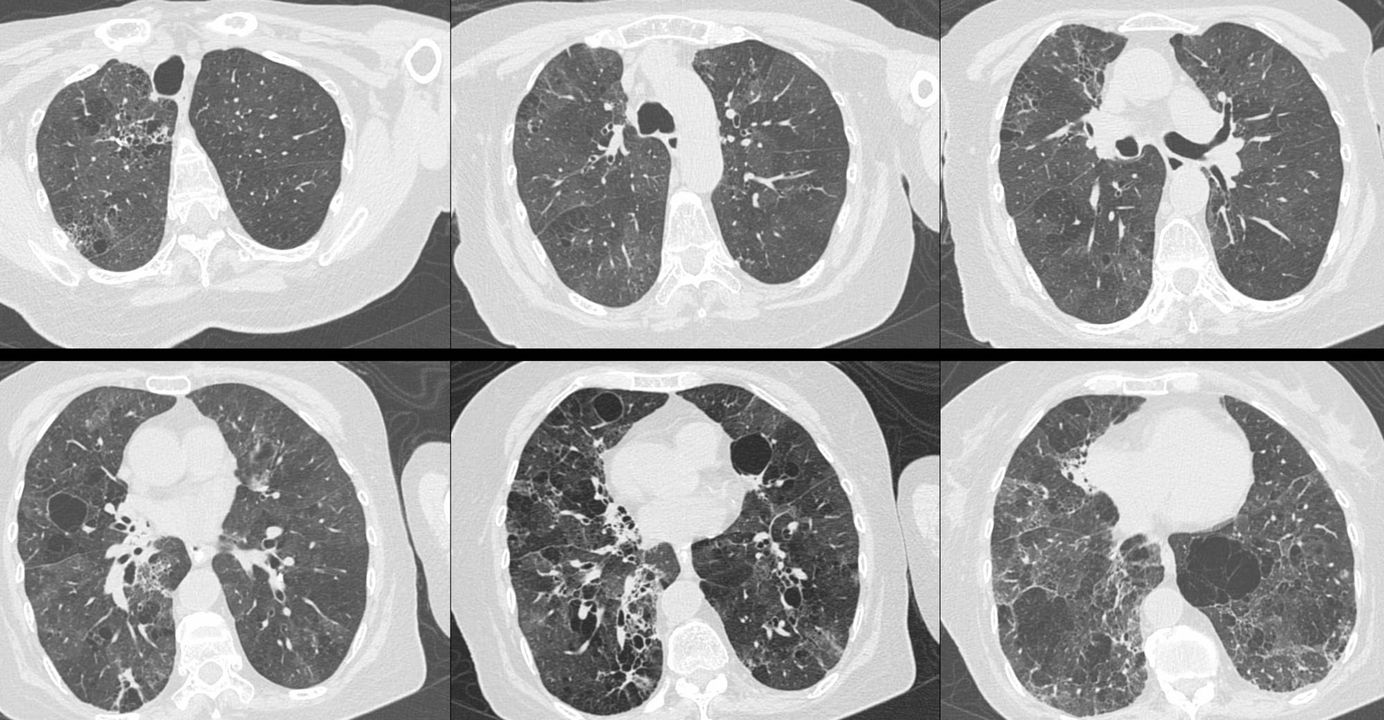
60-years old with a usual interstitial pneumonia (UIP) pattern first presented in Jun 23.

The coronal image showed a straight-edge sign and the anterior upper lobes showed more honeycombing than the bases.

He was worked up for connective tissue disease, but all the markers were negative.

He had 3 more scans till the last one of April 2026.

This April 2026 scan shows marked increase in the fibrosis, traction bronchiectasis and honeycombing.

There was rapid progression from June 23 to April 26.

If you see the rate of progression, this is a rapidly progressive ILD (RP-ILD) phenotype, commonly seen with inflammatory myositis associated ILD. However, it is conceivable that in some instances, any ILD, including IPF, which this would now be diagnosed as (idiopathic since there is no etiology) could progress rapidly.

He has been extensively worked up but till Apr 2026, there was no obvious cause found. Genetic studies have been non-contributory.

Here is a short video, where I go through the case on Osirix.

I also did a video, case of the day 80 on this subject last year (see below).


Previous Similar Posts


Index and Table of Contents

116 Cases with Videos
10 Cases with Posts
31 Snippets
16 Lectures
35 Cases of the Day (CODs)
New Series - ILD Patterns (3 Done)

Index and Table of Contents
Technical and Practice Issues * Case 11: 62-years old misdiagnosed to have interstitial lung disease - mid-inspiratory and expiratory scans * Snippet 03: Radiation risk and CT chest * Case 23: 60-years old - 40-pack years smoker - right upper lobe nodule - resolved using “mean” reconstructions…

New One-Time, Lifetime Subscription

Please check out this page to see the changes in subscription models.

Payment
To make the site more accessible, we have decided to remove the yearly subscription and keep only a one-time, lifetime payment to get access to all content at www.ctchestreview.com and www.ctbiopsy.com. These sites are linked and hence one payment gives access to both sites, but the

Previous Posts:

COD 199 - Two PAVMs, Two Patterns
PAVMs are usually easy to diagnose with specific points that need to be mentioned in the report.
ILD Patterns - The Variant UIP Pattern
UIP and sometimes NSIP can present with signs that point towards the likelihood of connective tissue disease ILD (CTD-ILD) and it is helpful to be aware of these signs
ILDRP-ILD

Comments